Background
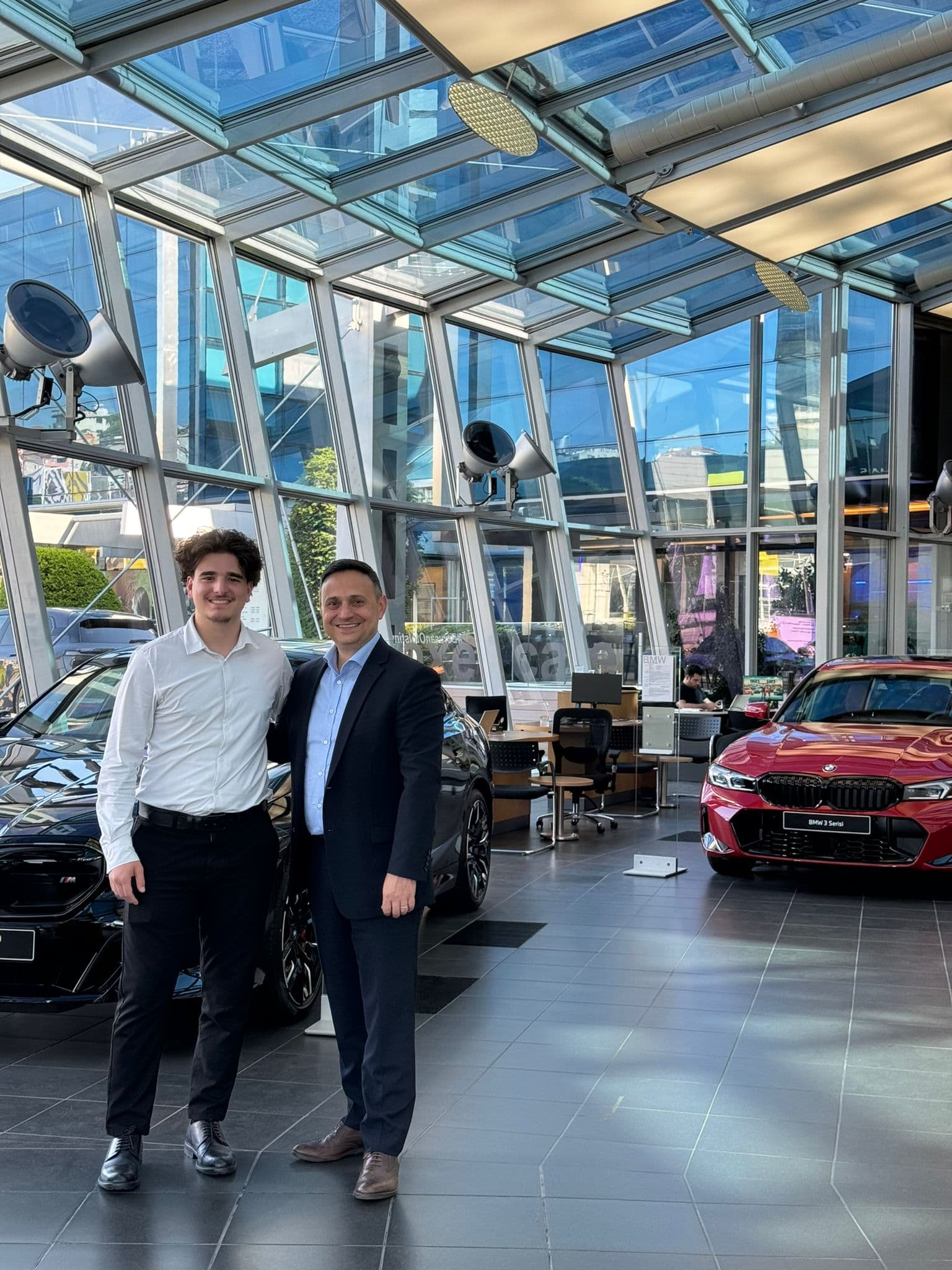
This was my first real internship, the kind where you walk into a building on day one and have no idea what the next four months will look like. BMW Türkiye was the place where I stopped studying how businesses work and started seeing it first-hand. The scope of the role was intentionally broad: customer experience, digital strategy, loyalty, data, marketing. I touched all of it.
What made it memorable wasn't any single project. It was the breadth. One week I was mapping business processes in PowerPoint for a digitalization pitch. The next I was writing SQL queries in SAP, sketching ERD diagrams on paper, or designing the tier structure of a loyalty program. Then I'd show up to a video shoot for Earth Day with an NGO partner, asking people questions on camera about sustainability. The learning came from the exposure to different departments, different problems, and different ways of thinking about the same customer.
BMW Türkiye operates at the intersection of a global brand with strict standards and a local market with unique dynamics. Presentations were given in two languages. Campaigns had to fit both the premium brand identity and the reality of what Turkish consumers expected. Cross-functional meetings pulled in CX, Sales, and Customer Service, all with different priorities and different metrics for success. For a first internship, it was the best possible crash course.
The Digitalization Pitch
A major part of my early work was helping build the business case for shifting BMW Türkiye's operations further toward digital. This meant taking existing manual processes, documenting them end-to-end, and constructing a presentation that showed leadership what the digital alternative could look like and why it was worth the investment.
Process Mapping
The foundation of the pitch was process mapping. I documented workflows as sequential step diagrams: boxes connected by arrows, each step labeled with the action, the team responsible, and where handoffs happened. The goal was to create a clear visual of how things worked today so you could see the friction points without anyone explaining them.
The process maps followed a consistent structure: identify the current process, map the as-is flow, design the to-be flow, pitch the changes internally and externally, and roll out. Each step was a box. Each transition was an arrow. The simplicity of the format was the point. A single slide had to communicate what might otherwise take a 20-minute explanation.
Presenting the Case
Building the content was only half the job. The other half was learning how to present it. I spent real time on text spacing, slide hierarchy, and visual consistency in PowerPoint, the kind of detail work that determines whether a stakeholder reads your slide or skips it. Every element had to earn its space.
More importantly, I learned the difference between internal and external pitches. Internal presentations to leadership emphasized efficiency gains, cost reduction, and operational risk. External pitches to partners and vendors focused on customer impact, brand alignment, and scalability. The same data, framed differently depending on who was in the room. Presenting in both Turkish and English added another layer because it required adjusting tone and emphasis for each audience, not just translating words.
Loyalty Programs
BMW's loyalty operation was one of the most complex areas I worked on. Loyalty in automotive isn't like retail loyalty. It's not points and discounts. It's about building a long-term relationship with someone who will own a car for years and needs regular service, upgrades, and engagement to stay within the brand ecosystem.
Program Architecture
I worked on the structure of BMW Türkiye's loyalty tiers: Private, Exclusive, Premium, and Prelude. Each tier served a different customer segment and carried different benefits, engagement models, and service expectations. The challenge was designing these so they felt distinct and valuable at every level, not just at the top.
Within each tier, I helped define the key dimensions that shaped the customer profile. These weren't arbitrary categories. They mapped directly to how BMW wanted to engage each segment.
| Dimension | What It Defined |
|---|---|
| Purpose & Vision | Why the tier exists and what it aims to achieve for the customer |
| Profile | Demographics, purchasing behavior, and ownership history |
| Current Coverage | Existing services and benefits the customer receives today |
| Continuous Engagement | Touchpoints and interactions that keep the customer active |
| Benefits | Tangible perks, service advantages, and exclusive access |
I also reviewed proposals from vendors and internal teams about extending the loyalty program. The review process taught me how to evaluate trade-offs: what sounds good on paper versus what actually moves customer retention metrics. Not every feature belonged in every tier, and deciding what to leave out was as important as deciding what to include.
After-Sales Value
One of the most important things I learned at BMW was that after-sales is where the real money lives. Selling a car is a one-time event. Service visits, maintenance packages, and upgrades over the ownership lifecycle are the recurring revenue engine. Loyalty programs exist to keep customers coming back for service instead of going to independent shops.
Understanding this changed how I thought about every piece of the customer journey. Every touchpoint, from the KMI form on the website to the campaign email to the service appointment, was designed to pull the customer deeper into the BMW ecosystem. The loyalty program wasn't a nice-to-have; it was the core business strategy for long-term revenue.
Data Foundations
This internship was where I first got my hands on real-world data systems. Not textbook examples, but actual production databases, messy exports, and the kind of normalization problems that only show up when real humans have been entering data for years. It was a crash course in how data actually works in a large organization.
ERD & Normalization
I learned to design Entity-Relationship Diagrams from scratch. Not in a classroom, but by analyzing BMW Türkiye's actual data and mapping out how customers, vehicles, service visits, and loyalty entries related to each other. I drew these by hand before formalizing them digitally, learning the notation as I went: one-to-one, one-to-many, many-to-many relationships, and the symbols that represent them.
The normalization work was about understanding data dependencies. Why does this field belong in this table? What happens if we duplicate it? Where do the keys connect? I learned to categorize data, identify redundancy, and trace the flow of information through a system. These were foundational skills that I'd use in every technical role after this, but this was where I built the intuition.
Beyond diagrams, I spent time analyzing BMW Türkiye's website and breaking down their data process: what forms collected what information, where it was stored, how it moved between systems, and where gaps existed. This was my first experience looking at a real-life application and reverse-engineering its data architecture.
SAP & Data Exports
Most of BMW Türkiye's operational data lived in SAP. I learned to navigate the system, run queries, and export data into Excel for analysis. The process wasn't glamorous. It was careful, methodical work that required understanding what each field meant and how the data was structured upstream.
Once the data was in Excel, I used pivot tables and functions to transform raw exports into something useful. Comparative analysis against competitor data, trend reports for leadership, and service metrics that needed to be explained in meetings. I also learned SQL fundamentals through the work: keys, joins, and the logic behind how relational databases connect information.
| Step | Tool | Output |
|---|---|---|
| Extract | SAP | Raw data export for selected date ranges and segments |
| Transform | Excel | Pivot tables, formulas, and cleaned datasets |
| Analyze | Excel | Comparative reports and competitor benchmarking |
| Present | PowerPoint | Visual summaries and recommendations for leadership |
Process Design
Beyond mapping existing processes, I worked on designing new ones. The common thread was self-service digitalization, taking interactions that currently required a phone call or dealership visit and making them available online. Every design started with the same question: what's the best journey for both the customer and the business?
Digital Journeys
I contributed to ideation sessions for new digital initiatives, helping map customer experience flows from first touchpoint to conversion. The work involved building road maps for how BMW Türkiye could move more of its business-to-customer interactions online: service booking, information requests, campaign enrollment, and loyalty program engagement.
Each digital journey was a balance. The customer wanted speed and simplicity. The business needed data capture and conversion tracking. The brand required a premium feel at every step. Designing for all three constraints simultaneously was harder than I expected, and it taught me that customer experience design isn't about the customer alone. It's about the intersection of customer needs and business objectives.
KMI Web Forms
One concrete output was engineering KMI (Keep Me Informed) website forms. These were the primary capture mechanism for potential customers who weren't ready to buy but wanted to stay in the funnel. The forms needed to collect enough information to segment the lead without creating friction that would make them abandon the page.
This was my first experience with the trade-off between data richness and conversion rate. More fields give you better data but fewer completions. I worked on the form structure, field selection, and how the captured data flowed into downstream systems for follow-up. It was a small piece of the overall digital strategy, but it was the piece that connected the website to the sales pipeline.
Campaigns & Marketing
I didn't just analyze campaigns. I helped build them. From tier structures and pricing to demographic targeting and actual on-location shoots, the marketing work gave me end-to-end exposure to how campaigns go from strategy to execution in a large organization.
Campaign Design
I designed marketing campaigns with different tiers, perks, and price allocations tailored to different customer demographics. Each campaign needed a clear project plan: who it targeted, what they received, how much it cost to deliver, and what the expected return was. The prioritization was constant: delegation, simplification, prioritization, because there were always more ideas than resources.
Fundraising campaigns added another layer. These required careful attention to detail: which details mattered to donors versus which were operational overhead, how to simplify the message without losing the impact, and how to delegate execution across teams without losing quality control. Project planning at BMW wasn't theoretical. Every campaign had a budget, a timeline, and real consequences if the targeting was off.
On-the-Ground Marketing
BMW Türkiye partnered with an NGO, and I was part of the team that went on location for an Earth Day shoot. We went outside, set up, and I asked people questions on camera about sustainability and environmental responsibility. This was first-hand marketing, not designing a campaign from a desk but being in the field creating content.
The experience crystallized something about marketing that spreadsheets and presentations can't teach: the gap between how a campaign looks in a planning document and how it feels in the real world. Talking to real people, capturing genuine reactions, and working within the constraints of a live shoot (timing, weather, people's willingness to participate) was a different kind of problem-solving entirely.
Cross-Functional Work
Almost nothing I did at BMW existed within a single department. The loyalty programs involved CX, Sales, and Customer Service, three teams with different goals, different KPIs, and different ideas about what mattered most. CX cared about journey quality. Sales cared about conversion. Customer Service cared about resolution speed. My job was often to sit in rooms where all three perspectives were represented and help synthesize them into a coherent direction.
Reviewing proposals became a regular activity. Internal teams and external vendors would submit ideas for loyalty features, campaign concepts, and digital tools, and I was part of the group that evaluated them. This meant reading decks, asking questions, comparing approaches, and developing a point of view on what would actually work versus what was aspirational.
Presenting in two languages was a constant. Turkish for internal teams and local partners, English for global BMW stakeholders and documentation. This wasn't just translation. It was adjusting context, cultural references, and emphasis depending on the audience. A pitch to BMW headquarters in Munich required different framing than a presentation to the Istanbul sales team, even when the underlying recommendation was identical.
Takeaways
I walked into BMW not knowing what a process map was, what SAP looked like, or how a loyalty program actually worked. I left with a feel for all of it. Not mastery, but enough context to understand how data, marketing, sales, and CX connect inside a real organization. That wide exposure ended up being more valuable than going deep on any single thing would have been, because every role I've had since then builds on that intuition.
The biggest surprise was learning that the car sale isn't the point. The service visits, the loyalty tiers, the campaign emails, the KMI forms on the website. All of it exists to keep the customer coming back after they've already bought. The real relationship starts after someone says yes. That idea changed how I think about every product and customer interaction.
Presenting in two languages forced me to stop thinking about what I wanted to say and start thinking about who was listening. The same recommendation needed completely different framing for an Istanbul sales meeting versus a global stakeholder call. I still use that instinct constantly.
And the data work gave me something I couldn't have gotten from a textbook. Real SAP exports with missing fields. ERDs drawn on paper before I knew the proper notation. Figuring out why a table had duplicate keys and tracing it back to how someone three years ago decided to structure a form. That messiness is where the actual learning happened.